
Metric Definitions:
-
P1 Propulsive Impulse: The propulsive impulse applied during the first half of the propulsive phase.
-
P2 Propulsive Impulse: The propulsive impulse applied during the second half of the propulsive phase.
-
P1|P2 Propulsive Impulse Index: The ratio of the propulsive impulse applied during the first half of the propulsive phase to the propulsive impulse applied during the second half of the propulsive phase.
The figures below hopefully bring the above definitions to life.
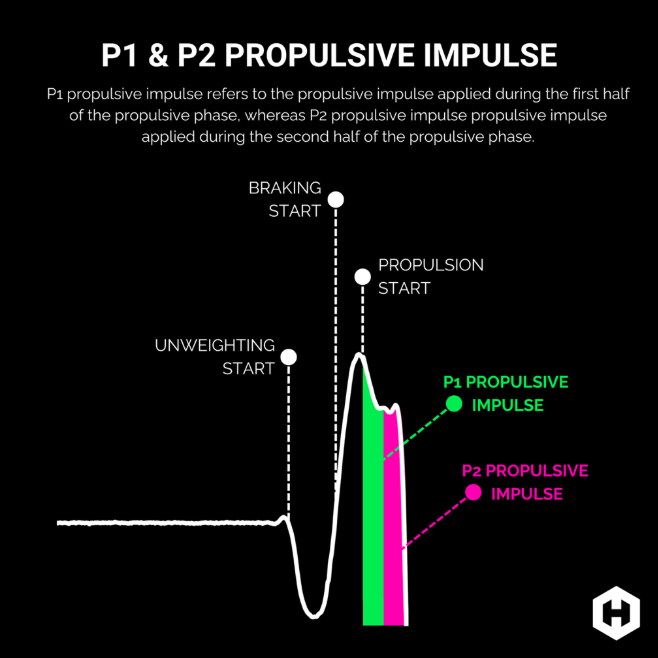
Splitting the propulsive impulse of a vertical jump into the first and second halves was first done by Jordan et al. (2015). They applied this to the squat jump and observed differences in interlimb asymmetry between ACL-R (anterior cruciate ligament reconstruction) and uninjured skiers for P2 propulsive impulse that weren’t seen in either the braking phase of a countermovement jump or the first half (i.e., P1) of the squat jump. The authors suggested that deficits and asymmetry in P2 propulsive impulse might have been due to chronic knee extensor strength and power deficits associated with ACL injury.
Not many other studies have explored the P1 and P2 propulsive impulse metrics despite them being of interest to some force plate users. Perhaps this is because propulsive impulse as a whole in the countermovement jump has also been shown to be reduced in ACL-R patients both compared to their pre-injury scores and compared to their asymptomatic limb when comparing individual limb force contributions (de França et al. 2025). Nevertheless, we recognize that just because there is little published evidence to support certain metrics doesn’t mean that they couldn’t add value to the many users of our force plates.
We do know that P1 propulsive impulse was found to be among the most reliable CMJ metrics with only two repetitions required to achieve reliable results across NCAA Division 1 athletes from different sports (Huebner et al. 2025). It was suggested that P2 propulsive impulse, like jump height and several others, require 4 trials to achieve reliability in the cohorts tested. It’s important to note that our force plate system and software wasn’t used in the study by Huebner et al. (2025) and the reliability of all metrics are cohort specific and so should be interpreted with these things in mind.